Contemporary Art: The New Always Comes
by Mirtes Marins de Oliveira
Hello, I am Mirtes Marins de Oliveira, researcher, curator, and professor. From now on, we will explore contemporary art through counter-narratives, which challenge hegemonic histories, and artists of the current generation who, for reasons we will discuss later, form a new category of contemporary historical figures. This is an audio guide prepared by me for SP-Arte, with the support of I Love Prio for the 21st edition of the fair.
Art production today is perceived in its complexity and plurality of perspectives. In our society, exchanges and confrontations of worldviews are systematic and intense. They generate positions, affirm values, and promote new understandings of art, its practices, and its social functions.
Far from some modernist tendencies that proposed a universal language and a utopian purpose for art, post-World War II art offers a diversity of viewpoints. It is an opportunity to think about the planet from multiple perspectives, evoking imagination and transformation.
Among the many possible approaches, we have chosen two: counter-narratives and contemporary historical figures.
Counter-narratives address ways of understanding art and its meanings through ethnic, cultural, historical, and material differences. These are stories that challenge hegemonic ones and seek to reconfigure the artistic field. They provoke shifts in perspective that can transform the understanding of concepts such as art, the artist, and their roles. And also of society itself.
Meanwhile, Contemporary Historical Figures point to the speed and volatility of life production. In this context, artists considered contemporary are part of a universe of references that form another layer between modernisms and present-day productions. Even though they are close in time, they already appear distant and historical due to their engagement with themes, materials, and contexts that younger generations have not directly experienced—except through books, documentaries, or retold history.
Let’s begin our Counter-Narratives tour by introducing some artists showcased in galleries present at SP-Arte 2025, starting on the 2nd Floor of the building. I want to remind you that an exhibition setting is different from reading or simply looking at images in a book, for example. In exhibitions, the environment impacts our experience: lighting, sounds, movement, and the varied rhythms of people circulating. This ambiance makes all the difference in how we understand what we see. Observing the fair experience contributes to our comprehension of contemporary life and the roles of art within it. SP-Arte is an exhibition that contains many others.

Jimmie Durham for LABINAC, Arboletier, 2021, stainless steel, Murano glass, LED light, and dichroic glass. Photo: José Pelegrini
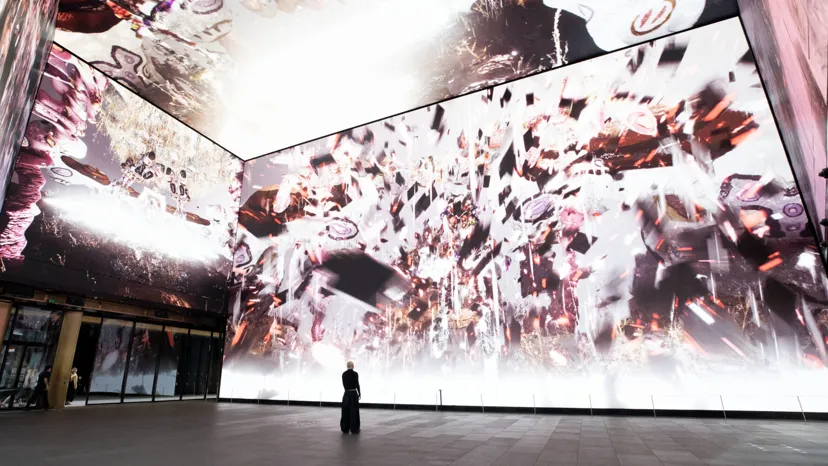
We begin with an artist whose work emphasizes the contemporary context: Gabriel Massan, who is featured in the newly inaugurated Yehudi Hollader-Pappi gallery, located in São Paulo and focused on video, performance, painting, and sculpture, present at the fair at Stand E05.
Massan was born in Rio de Janeiro and currently lives in Berlin. His work is characterized by a dialogue with the universe of computational technologies in its own specificity, which includes video games, 3D animation, and distinctive soundscapes, resulting in works that generally emphasize interactive and immersive installations. However, this practice is not confined to a mere fascination with technology. On the contrary, Massan observes the inequalities in his surroundings and, in his works, seeks to create his own worlds, provoke reflections based on cultural contexts, and, in his own words, explore dissonances and distortions—particularly in the experience of being an immigrant living in Europe and the specificity of being a Latin American of Afro-Indigenous descent. These inequalities, in his proposals, are transformed into an experience of differences as a way of understanding the world from another perspective.
Despite being young, Massan has already received critical acclaim, with solo exhibitions at the Pinacoteca do Estado de São Paulo (2024-2025), Laboratorio Arte Alameda (2024), Outernet Arts (2023), and Serpentine Galleries (2023) in London.
Continuing our visit, I suggest stopping by the Martins&Montero gallery at Stand F13, which presents Jimmie Durham for LABINAC. Jimmie Durham, who passed away in 2021, was an important North American artist and activist involved in the struggles for Indigenous rights. Since the 1990s, he had lived in Europe, where he and his partner, artist and activist Maria Thereza Alves, founded LABINAC—a design collective aimed at supporting the artisanal work of Latin American Indigenous peoples and creating objects that blur the lines between furniture and sculpture. Interested in the materiality of artifacts and their potential for reuse, Durham designed and produced some of these objects, an activity he had been engaged in since childhood. A prominent contemporary artist, he was awarded the Golden Lion at the Venice Art Biennale in 2019.
At Galeria Leme (Stand D07), we find a work from the Máscaras Mestizas series (2024) by Peruvian artist Sandra Gamarra Heshiki, which was exhibited at the Spanish Pavilion during the 60th Venice Biennale. Gamarra’s work raises concerns that resonate with our journey through the fair, as she constructs her pieces against the backdrop of exhibition and artistic models that have been consecrated but also reveal their oppressive nature—particularly in the colonial processes of the Americas. According to Agustín Pérez Rubio, curator of the Spanish Pavilion, the Máscaras Mestizas series exposes the colonial practice of portraiture as, in his words, a "factory of representation." These widely recognized portraits of aristocracy and monarchs function as time capsules intended to immortalize political and social norms. In these works, Gamarra establishes a counter-narrative through a critical and forceful simulation of the art world's narratives, exposing and highlighting their persuasive structures.

Nadia Taquary, Oriki é o que não se vê Series (2021-2024), ipe wood, bronze 70, straw, and lagdba. Photo: courtesy
The work of Carlos Garaicoa, featured at Stand E07 of Galeria Almeida & Dale, is part of the Puzzles series, created between 2018 and 2022. From a material perspective, this series presents photographs of deteriorated architecture and urban spaces printed as jigsaw puzzles, with a faded, undefined version of the same image in the background. Placed inside an acrylic box, the artwork includes not only these two images but also, in the foreground, disassembled puzzle pieces, alluding to urban decay—a recurring theme in his work. The specific piece, titled Table and Lyon Mountain, references Table Mountain and Lion’s Head, mountains located in Table Mountain National Park. Garaicoa’s work critically addresses the modernist legacy, in which city planning was also an attempt to organize society—an idealistic project dismantled by the harsh economic and political conditions that have transformed urban spaces and buildings into ruins.
Garaicoa, a Cuban artist with a three-decade career, has participated in some of the most important international exhibitions, including Documenta 11 in 2002 and Documenta 14 in 2017, as well as major biennials such as Venice and São Paulo.
At Galeria Verve, Stand D11, Bahian artist Nádia Taquary presents works from the series Oriki: é o que não se vê (Oriki: It Is What Cannot Be Seen), three-dimensional pieces connected to the tradition of orixá worship. Orikis are salutations to Yoruba deities that, in practice, invoke the protection and power of the orixás. In her works, Nádia Taquary highlights ancestral heritage and emphasizes the historically erased role of Black women in cultural transmission.
The presented work specifically evokes the worship of the Iyami, particularly within the Gelede society, where women wear masks—represented in Taquary’s pieces through the use of bronze. The Iyami cult honors the Ancestral Mothers, who, in various patriarchal contexts, were persecuted as witches and accused of malevolent practices, leading to widespread misconceptions, prejudice, and violence. With these and other works, Taquary celebrates, values, and reclaims the ancestral power of Black women. Her pieces are currently exhibited worldwide, including at the Sydney Biennale, the Museum of Art of Rio (MAR), the Institute for Studies on Latin American Art (ISLAA) in New York, and the Museo Nacional Thyssen-Bornemisza, among others.
To conclude our Counter-Narratives itinerary, we head to Galeria Aura at Stand E09, where we encounter the work of Rommulo Vieira da Conceição, a Bahian artist who deliberately challenges established and crystallized modernist narratives.
With a background in Geology, Rommulo observes, reinforces, and critiques certain aspects of modernist production, which was built upon the ideals of universality, functionality, and the convergence of art and design. In contrast, he subverts these premises, demonstrating that in contemporary art, the emphasis is on the opposite: cultural specificity rather than universalist assumptions, and dysfunctionality rather than functionality. By incorporating visual elements frequently used in modernist design—such as geometric shapes and primary colors—he recontextualizes them within the field of art.

Francis Alÿs, The Sign Painting Project,. Photo: Ding Musa
We now turn to artists we can call Contemporary Historians, some of whom are still active and have, through the circulation and discussion of their works, become historical figures themselves, serving as references for understanding contemporary art by new generations of artists. Let’s start with a visit to the Galeria Luisa Strina, at Stand E03, which will present works by Cildo Meireles. Meireles began his career at a very young age, with controversies such as the installation Tiradentes: Totem - Monumento ao Preso Político (1970), presented at the exhibition Do corpo à terra, organized by Frederico Morais in Belo Horizonte.
The work presents thematic elements that are recurring in his works, such as politics, the history of the country, capitalism's strategies present in daily life, violence, among many others. In this sense, his multifaceted production avoids a formalist characterization, allowing people to recognize something as a visual pattern in his works. On the contrary, each work is thematically narrative and belongs to a specific universe, requiring the participants' reflective engagement. The importance and circulation of his works are immense, with international recognition and a strong influence on the formation of other young artists.
The Galeria Galatea, at Stand F06, brings the work of Belgian artist Francis Alÿs from a series called The Sign Painting Project, paintings made in Mexico City, where the artist lived, during the years 1993-1997 in collaboration with commercial sign painters known as rotulistas: Juan Garcia, Enrique Huerta, and Emilio Rivera. The process consists of small-scale paintings made by Alÿs, which were then enlarged and reworked by the rotulistas, resulting in over a hundred works.
Alÿs is an extremely critical artist who, in his works, addresses aspects related to the value and very definition of art, while also displaying layers of possible meanings related to social practices. The gallery presents the diptych Cat nº9 (1997) in collaboration with Juan Garcia, one of the original rotulistas who worked on the pieces in the 1990s. Cat nº9 provokes reflections on collaborative and dialogical art, while at the same time challenging the differentiation between commercial art and art made by traditionally trained artists, recognized by critics.
Mina de verde 03 (2006-2021) is a work by Amélia Toledo from the Minas de cor series, shown at the Galeria Nara Roesler, Stand E0. The work is an example of the artist's interest, who passed away in 2017, in the chromatic and poetic aspects of natural elements, which she collected profusely, such as stones and shells, common in many of her works. This approach, when the works circulated, created a hypnotic and immersive relationship with visitors, allowing them to travel through a world of fantasy and stimulating young artists to look at elements of nature and landscape.
The gallery emphasizes the artist's formative trajectory, as she created her own universe of creation after an initial period of traditional learning with other significant artists in Brazilian art history, such as Anita Malfatti, Yoshiya Takaoka, and Waldemar da Costa, in addition to generational exchanges with artists from the Neoconcretist movement like Hélio Oiticica and Lygia Pape.

Olga de Amaral, FiberWall (1983). Photo: Galeria CasaZirio
Continuing with our Contemporary Historians route, we turn to Stand F05 of the Galeria Vermelho, which presents works by Carmela Gross, whose career began in the late 1960s in an experimental and iconoclastic context, starting with an exhibition at Rex Gallery & Sons. A globally recognized artist, Gross stands out for her work at the University of São Paulo, where she taught in the Department of Visual Arts, contributing for decades to the formation of numerous artists. Gross's works focus on urban and architectural aspects from a critical, political perspective, often with subtle ironies. She seeks to provoke a sense of strangeness through the location of her works, often in public and/or institutional spaces, also encouraging passersby to perceive the specificity of the places.
Now we move to Stand D10, which presents Retângulos 3 (1968), by Ascânio MMM, shown by the Galeria Silvia Cintra + Box 4. This work is a significant example of the Brazilian geometric tradition that characterizes the artist’s work, as well as an understanding of certain Brazilian and Latin American production outside the continent. Created based on the principles of the constructive and concrete legacy, for which art is understood as analogous to science, particularly Mathematics, valued for its rational aspects and distancing from emotional or expressionist dimensions. This concept also aligns art with the industrialized world, thus engaging in a strong dialogue with design and architecture production in certain modernist circles.
Finally, concluding the Contemporary Historians route, the gallery based in Colombia, Casa Zirio Gallery, present at Stand F11, showcases the incredible work of Olga de Amaral, which was exhibited in 2024 at the Fondation Cartier pour l’art contemporain in Paris. At SP-Arte, Amaral presents Fiber Wall (1983), a compelling example of her work that historically redefined textile art through the use of materials such as gold leaves and experimental techniques radicalized from traditional textile methods. As a result, Olga de Amaral creates monumental pieces that expand the understanding of art produced from fibers. This shift repositions textile production within the contemporary art circuit and surpasses the status of this practice, which in the modernist context was confined to a form of art made by women. The materiality, monumentality, and experimentalism in Olga de Amaral’s works challenge these conceptions and contribute to a broader and more diverse understanding of the category of art.